Buying a forklift safety system is easy. Making it work on a real floor, with real drivers and real shift patterns, is the hard part. A published warehouse case study (Arbill) describes a familiar pattern: close calls that kept happening despite lines, mirrors and training, and the "cautious acceptance" that greets any new system.
The difference between a system people trust and one they ignore is usually the process around it. This article walks through the seven stages we follow on every LED projection, collision avoidance and AI camera project. The most important one is the forklift safety site survey.
The regulatory frame, briefly
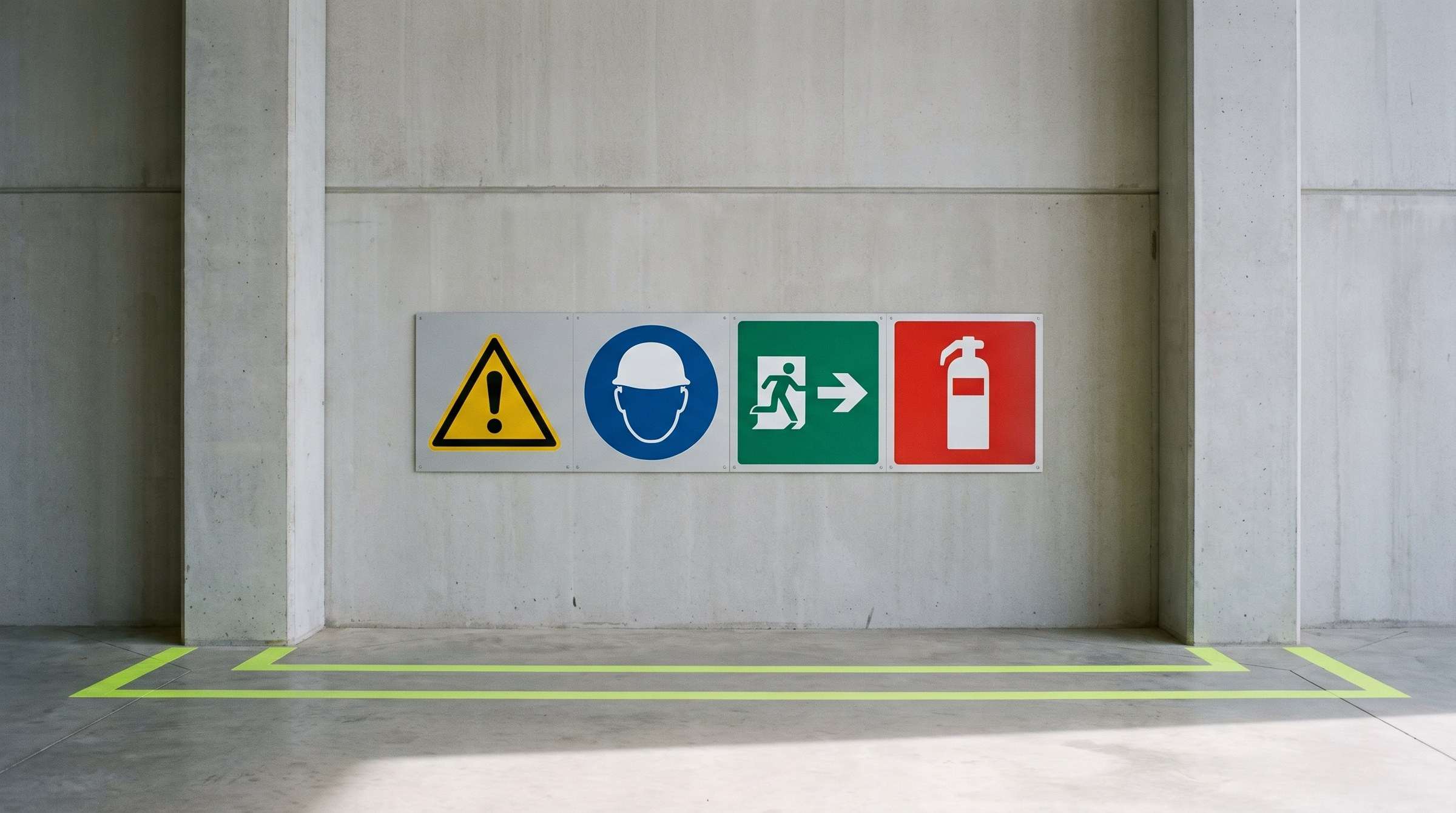
In the EU, Directive 89/654/EEC sets minimum requirements for workplaces, including traffic routes, and Directive 92/58/EEC sets the minimum requirements for safety signs. In Greece these are transposed by Presidential Decree 16/1996 and Presidential Decree 105/1995 respectively. ISO 7010 provides the registered pictograms, including W014 for forklift trucks.
If you run a management system such as ISO 45001, a collision avoidance project fits naturally into the hierarchy of controls and continual improvement. One date to note: the EU Machinery Regulation 2023/1230 applies from 20 January 2027 and is relevant when safety components or functions are added to machinery.
None of these frameworks tells you which technology to choose. That is what the survey is for.
Stage 1: Initial enquiry
It starts with a concern: a near miss at a dock door, a new layout, an audit finding, a corporate safety standard. At this point the useful thing is to describe the trigger as precisely as possible. "Pedestrians cross in front of reversing trucks at gate 3" is far more useful than "we need forklift safety".
Stage 2: Exploration
A first discussion records your core requirements and agrees the next steps. Typical questions:
- Which areas worry you, and why?
- What fleet do you run, and which truck types?
- Who walks the floor: staff only, or also visitors and contractors?
- Are there explosive atmospheres, cold stores or outdoor areas?
Stage 3: Site survey and risk assessment
This is where the project is really decided. A proper survey is a technical inspection on the floor, with a risk assessment for each point separately, not a generic walk-through.
What a good survey covers
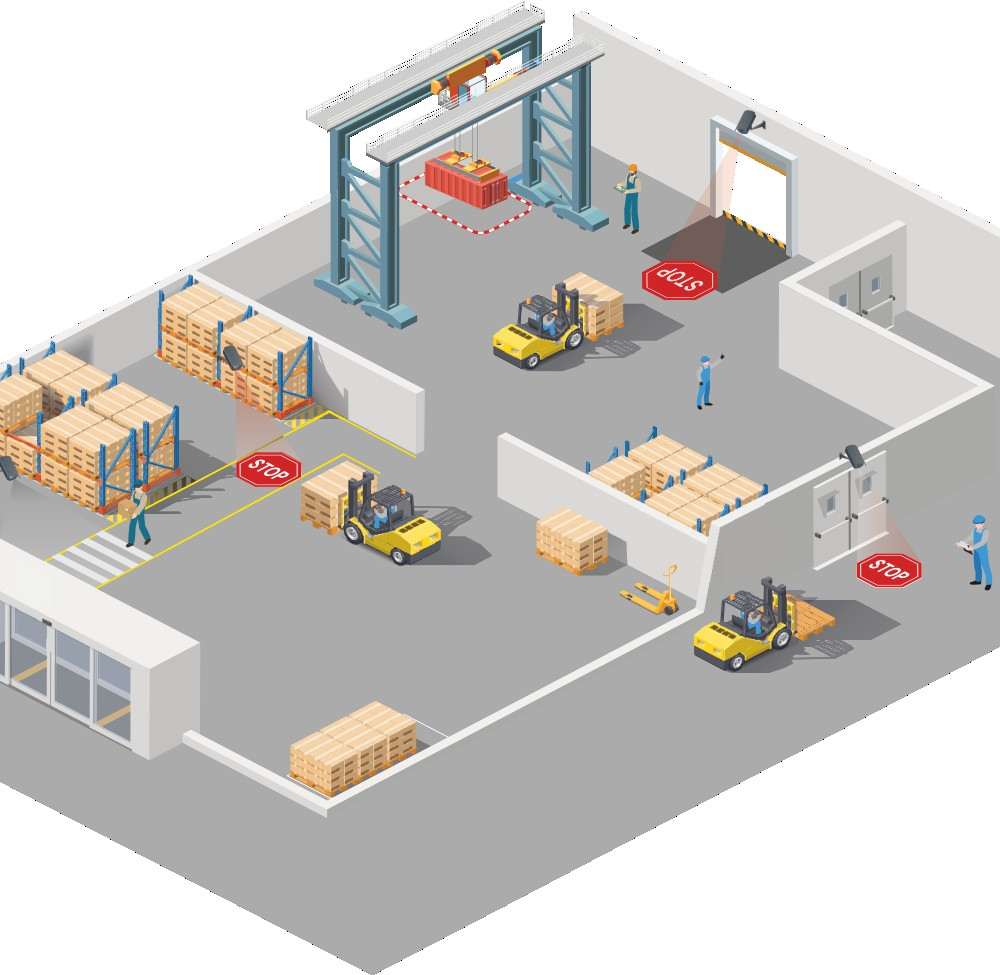
- Every interaction point: doors, crossings, rack ends, docks, junctions, crane areas.
- Sightlines: what blocks the view of the driver and of the pedestrian.
- Traffic: how many trucks, how fast, in which directions, and at which times.
- Mounting options: beams, columns and heights for projectors and mirrors.
- Floor and light: floor colour, dirt, ambient light, all of which affect projection.
- Fleet: truck types and whether each can take tags, cameras or speed control.
- Conditions: temperature ranges, dust, humidity, explosive zones.
What to prepare before the visit
A little preparation makes the survey far more useful:
- a site plan or layout drawing, even a rough one;
- your current risk assessment and any recent incident or near-miss reports;
- a list of truck types and how many of each;
- the areas where visitors, contractors or drivers from outside walk;
- any planned layout changes in the coming months.
Who should be there
Your safety officer, someone who knows daily operations, and ideally one or two experienced drivers. Drivers know the blind spots better than any drawing, and involving them early is the best way to win acceptance later.
Stage 4: Presentation and simulation
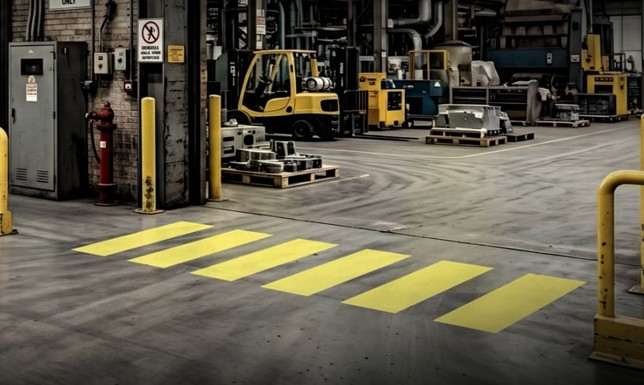
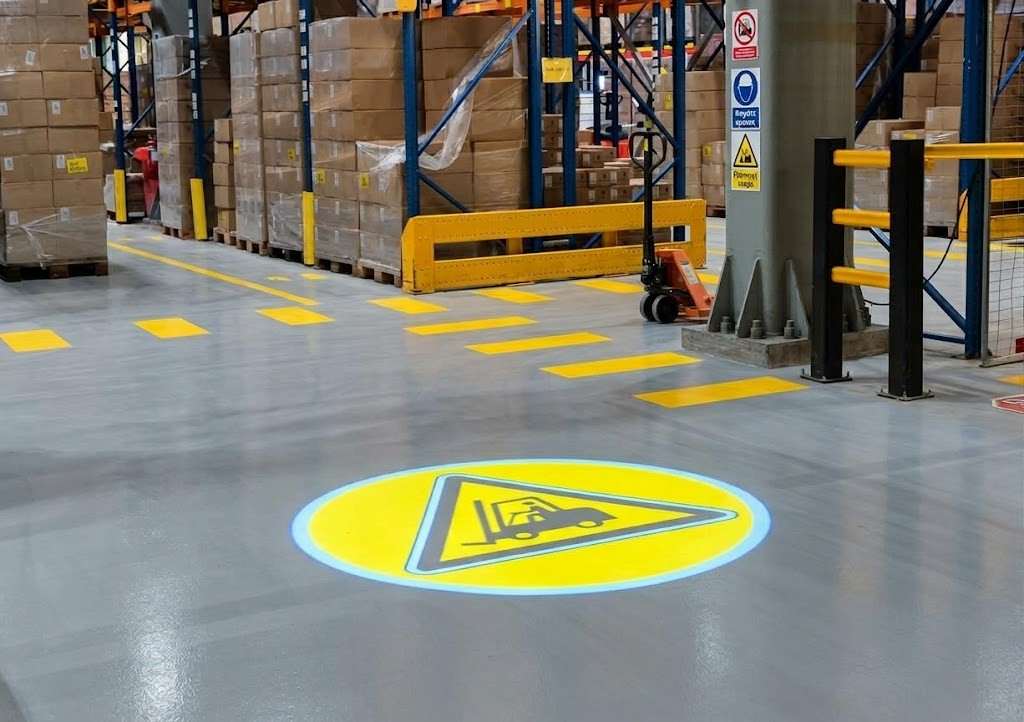
The proposed solution is presented in detail, point by point. The most useful part is a video simulation of your own space: you see the projected crossing at your actual door, or the forklift warning on your actual aisle floor.
A simulation answers questions no brochure can. Is the sign big enough from the driver's seat? Does it compete with other markings? Is the colour right on this floor? It is also the moment to adjust the plan, before anything is ordered.
Stage 5: Detailed quote
You receive a detailed cost breakdown, technical specifications and an implementation schedule. Check that it states, for each point, what will be installed and why. A good quote also makes clear what is optional: a projector that could be added later, an extra camera, an overhead height bar.
Stage 6: Installation
Installation and configuration are done by experienced technicians, certified for work at height and using all the PPE the job requires. The schedule is agreed in advance so that, as far as possible, work fits around your shifts.
Configuration matters as much as hardware. Warning zones, speed limits and trigger logic are set with you and tested on the floor. Plan a short briefing for drivers and pedestrians when the system goes live, so everyone knows what each signal means.
Stage 7: After-sales service
A safety system is not finished when it is switched on. The last stage covers continuous technical support, preventive maintenance and a prompt response when something needs attention. It is also when zones and thresholds can be fine-tuned, based on how drivers actually work.
Five mistakes to avoid
- Starting with a product. Start with the risk at each point.
- Skipping drivers. Systems imposed without them are the ones that get bypassed.
- Ignoring false alarms. A system that warns too often teaches people to ignore it.
- Forgetting data protection. Camera projects need a GDPR review before go-live.
- No owner after go-live. Agree who maintains and adjusts the system.
Next step
If you want to see how this works on your own floor, book a free site survey. You can also read how the seven stages apply to every Horus project, or compare technologies in our guide to forklift anti-collision systems. Common starting points are a virtual pedestrian crossing at the busiest door or an AI pedestrian detection camera on the trucks.